Artificial Intelligence stopped being a sci-fi theme long ago and has become part of our seeds (students) everyday lives. It’s in the apps we use, the searches we make, the video games we play, in transportation, on social media… and yes, also in the way we learn.
For a virtual school or a personalized school like Renfort, ignoring it would be like teaching without a notebook. It simply makes no sense.
That’s why, as part of Renfort’s Edtech Mission, we dedicated an entire month to thinking about AI, using it, questioning it, and examining it closely during the InnoFest 2025—an experience that helped us understand that AI isn’t just something that “makes school life easier.” It also helps shape critical thinking, ethics, and creativity from early childhood through adolescence. And yes, we also discovered plenty of digital tools that truly support students in 2025.
What we saw throughout the month is that AI is neither neutral nor automatic. It carries values, errors, biases, and possibilities. And above all, it has a real impact on how our seeds learn.
So here’s a look at what we did, what we discovered, and what we now recommend so that AI becomes an ally, not a shortcut, for students today.
First Encounter: Curiosity, Play, and the First Big Questions
We started from the basics: what do the seeds really know about AI? In Elementary, everything was playful. They sat in a circle, listened to a short story, and asked spontaneous questions to ChatGPT. Each seed picked a new idea and turned it into a possible use for AI. Pure curiosity, no fear of being wrong.
In Middle and High School, the environment shifted toward reflection. We analyzed how AI shows up in movies, video games, and everyday content. Questions emerged about bias, privacy, and how algorithms can influence emotions. Each group created five principles for a mini ethical code. The goal: learning to question.
Second Encounter: AI in Our Daily Lives
Here, we brought the theory down to real life. The students researched topics they were interested in using ChatGPT, compared responses, and discussed what kinds of questions generate better results.
They also identified real examples of AI in their surroundings: apps, smart transportation, and social media. They discovered that AI doesn’t live in futuristic labs; it’s on their screens, in their decisions, and in the way they interact with the world. And to use it well, you need to observe and ask with intention.
Third Encounter: Communicating With Purpose
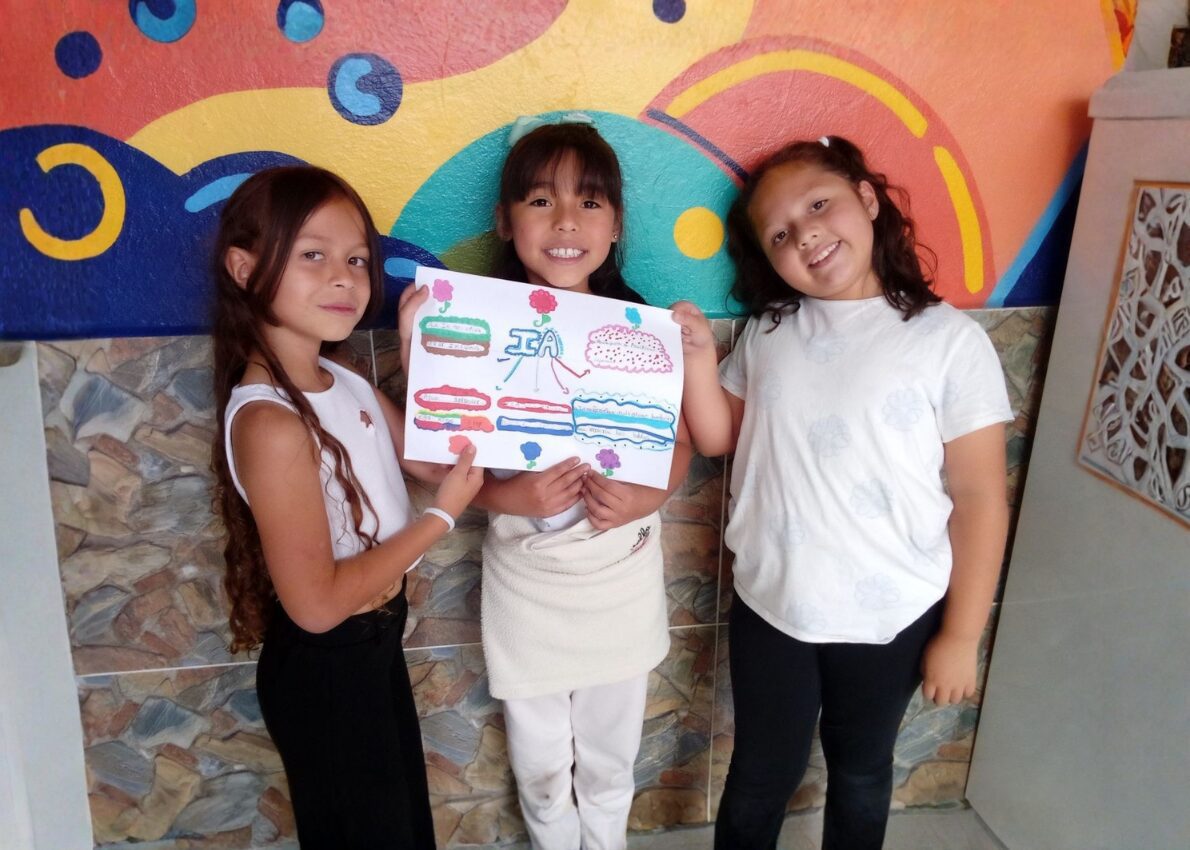
It was time to design. The seeds created posters about the responsible use of AI, with a clear title, three images, and three powerful statements. Privacy, bias, and ethics were the most frequent themes.
Then, each group presented its poster in a three-minute oral presentation. This revealed something essential: communicating about technology is also an ethical act. Visual messages teach, transform, and encourage reflection.
Fourth Encounter: Ethical Debates
The classroom became a space for deep conversation.
In Elementary, debating meant talking, listening, moving, and thinking through play.
In High School, the debates were more structured—almost like mini forums on tech ethics. The seeds questioned, argued, and compared ideas. They discovered that critical thinking is not about fighting; it’s about understanding better.
Fifth Encounter: Good Practices for the Future
The final activity was symbolic and powerful. In Elementary, each seed wrote a good practice for the responsible use of AI and placed it on a collective mural. Simple but sharp messages: “Don’t copy with AI,” “Ask respectfully,” “Use it to learn.”
In High School, the mural became a final space for reflection. They shared insights, concerns, and proposals for continuing to explore the topic. This closing moment made something obvious: the conversation about AI is just beginning.
This entire process has shown us that Artificial Intelligence is not just technology—it’s culture, ethics, and digital citizenship. And yes, it can also be a great ally for studying when used with criteria and purpose.
Digital tools that are genuinely useful for students in 2025
So here are some digital tools that are genuinely useful for students in 2025:
- ChatGPT and similar assistants: for research, language practice, and review (without replacing independent thinking).
- Perplexity: for deeper searches with clear sources.
- Khanmigo: is a digital tutor for math and science.
- Notion or NotebookLM: to organize ideas and projects.
- Canva and Adobe Express: are used to design presentations or posters with intention.
- Content verification tools: to strengthen critical thinking and avoid misinformation.
At Colegio Renfort, we believe technology isn’t a shortcut—it’s a path. A path to think, create, learn, and build digital culture with purpose. AI doesn’t replace humanity; it enhances it… when we use it wisely.
References
- Floridi, L. (2022). [cite_start]Ethics, Governance, and Policies in Artificial Intelligence. [cite: 117]
- Wiese Foundation. (2025, August 18). [cite_start]Ethics in the Use of Artificial Intelligence in Educational Processes. Fundación Wiese. [cite: 118]
- Paul, R., & Elder, L. (2014). A Miniature Guide to Critical Thinking: Concepts and Tools (7th ed.). [cite_start]Foundation for Critical Thinking. [cite: 119, 120]
If you want to learn more about Renfort, register your information here: